
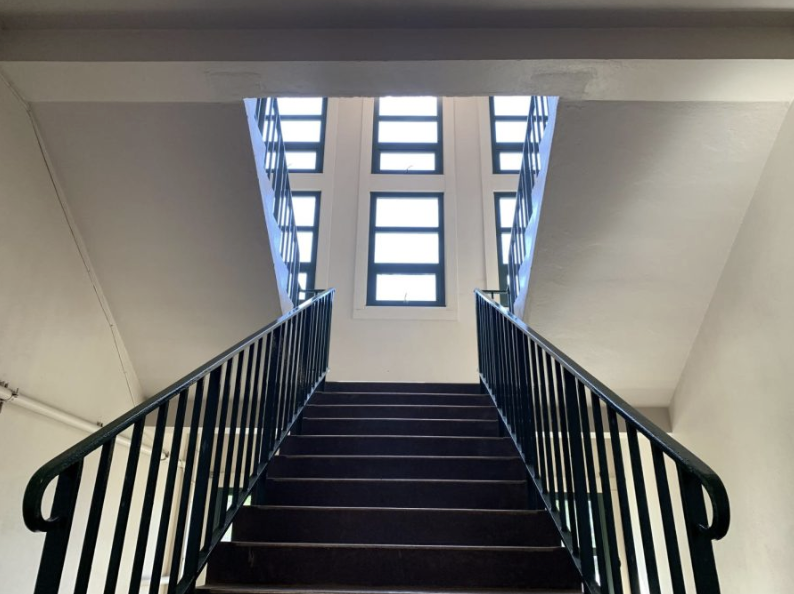
At the start of the fall 2025 semester, an unusually high number of students returned from summer break with serious injuries and mobility impairments. Two people, including myself, began the year in a wheelchair, and many more arrived on crutches or wearing braces. Our conditions varied widely, but we all shared one challenge: navigating Punahou’s inaccessible campus. Now, as the semester comes to a close, we have a moment to reflect on what helped us, what hindered us, and what needs to change. In preparation for Ka Punahou’s Spring 2026 print edition, I set out to evaluate Punahou’s approach to accessibility and its treatment of students with mobility issues.
To start, it is important to note the legal context. Punahou does not have to comply with the Americans with Disabilities Act for buildings constructed before 2001 or in historic structures where accessibility modifications would compromise their integrity. Furthermore, being technically within the boundaries of the law does not guarantee a dignified or comfortable experience for students. Our campus is one of the largest in the country, and while that comes with many benefits, it also results in significant challenges for anyone who cannot easily navigate long distances or steep terrain.
Mat Strombach ‘26, for example, encountered harsh challenges upon returning to school. After an exhausting class theatre trip to Scotland last summer, their muscles exploded, forcing them to be placed in a wheelchair. However, the school’s administration made it difficult for them to return, telling them they needed to halt their in-person Punahou education for online learning—while still paying tuition. Mat credits their mom, whose fierce determination to get the treatment they needed allowed them to stay in school and change their class locations. Still, not all of us were given that option, and the fundamental principle is that no one should have to fight for access to an equal education while injured.
My own experience, while milder than Mat’s, reflects many of the same challenges. Punahou kindly relocated two of my classes—one from the third floor of Castle Hall to the first floor of Bishop’s, and one from Bingham’s second floor to its first. I was grateful for these accommodations, but still found commuting to my classes painful, difficult, and at times humiliating. Classmates and teachers often offered to help push me to my classes, and I made several friends among the good Samaritans who shared my route. But when there was no one around, I had to pull myself. The worst part of my day was facing the ramp to Bishop’s basement, which hasn’t been resurfaced in decades. Several times, my wheelchair slipped out of control and slammed into a wall; once, the fall even broke my phone. My AP U.S. History class, held in the basement of Pauahi Hall—which has no ramp—was also not moved, so each day I relied on a friend to carry my wheelchair down and back up the stairs. When my parents asked whether I could receive golf cart transportation between classes, we were told the school has a policy against giving mobility-impaired students rides, out of concern that too many injured students would request them. I understand the need to draw boundaries, but to me, the solution seems straightforward: offer rides to students with a doctor’s note. For those of us who truly need assistance, that doesn’t feel like too much to ask.
To gain a better understanding of the problems students face with accessibility, I went to Principal Gustavo Carrera. When I asked him if he thought Punahou was doing a good job at accessibility, he responded, “I think that we are, which is an odd statement to make considering that so many of our buildings are not accessible. This building, where you sit right now, is actually not accessible in any way. It has steps to get up here on the first floor, and it also has steps to get into the lower level. We have four entrances, and none of them is realistically fixable at some level. However, we become more accessible in every building we create anew, like the Learning Commons, which is accessible. As are, you know, Mamiya, all of the new buildings are fully accessible.” When I asked if the Mary Kawena Pukui Learning Commons would be accessible, he responded in the affirmative. “Yes…It’ll have ramps. In fact, you can even see it now. If you look at it from behind, the main level and both entrances are at ground level. So you don’t even need a ramp.”
Following his answer, I then asked, “Why do you think so few students with mobility impairments attend Punahou, even though 3,000 minors in Hawaii are disabled? Why do you think so few disabled students apply to Punahou?
He replied, “I don’t think there’s been a study on how many people apply or not. I don’t see a discrepancy between the number of disabled students that we have, and it also depends on the kind of disability. Some of those students with disabilities may not find Punahou appealing for the reasons I listed earlier, in the same way that some public schools may not be appealing.”
My last question was about the policy that students cannot be given rides in golf carts.
“Okay, so to make two distinctions, if a student needs a wheelchair, they absolutely can use a wheelchair on campus,” said Principal Carrera. “Now, if they don’t need a wheelchair, that means that’s a temporary accommodation. We have offered that accommodation to students on occasion, but it’s a temporary accommodation. First of all, we just don’t have enough golf carts. We don’t have the personnel to offer rides to people who have temporary injuries. I don’t think it would be appropriate for us to be offering rides to any student who has suffered a small injury. But if they do, again, [we will provide support] temporarily and within what’s reasonable, but realistically, we don’t have the personnel.”
In conclusion, while Punahou has made efforts to improve accessibility, especially with the layouts of recent buildings, many impaired students still struggle to navigate our vast campus. I’m grateful for the accommodations I received this semester, as well as the support from family, friends, and teachers. While I believe the school is headed in the right direction, and while I am grateful for the accommodations I received this semester, we must continue to advocate for real and lasting changes to ensure that no future student struggles unnecessarily for access to their education.
I want to say a big thank you to Principal Carrera for his transparency in discussing Punahou’s current mobility issues and his commitment to making future buildings more accessible. I would also like to thank Mat Strombach ‘26 and everyone else who shared their stories, as their input helped paint a greater picture of the challenges faced.
Leo • May 11, 2026 at 9:39 am
Thank you for your insights!