
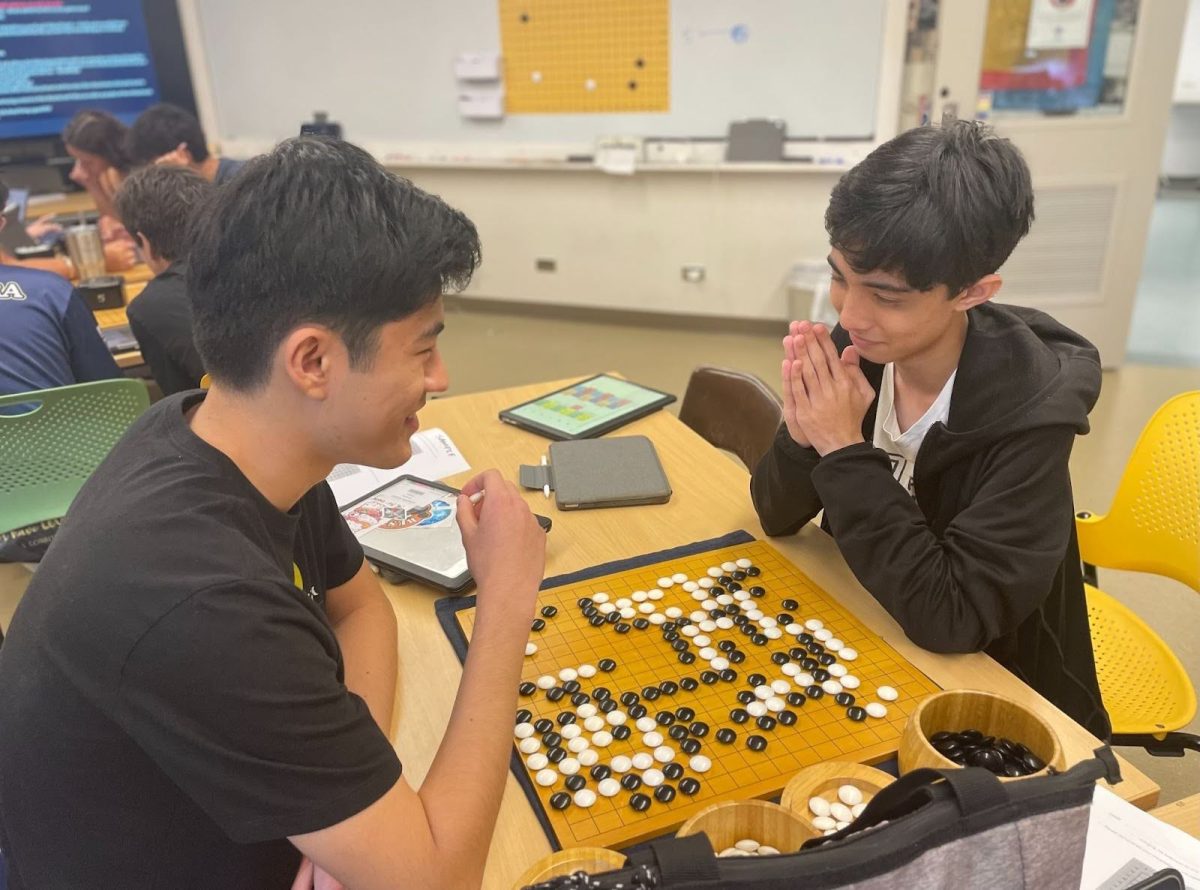
In 2008, the class Buddhist Philosophy and the Game of Go entered Punahou’s course catalog. A blend of philosophy and game theory, it’s the only class of its kind in the state.
Go is an ancient Chinese game in which two players compete to gain territory on a board by creating shapes with black or white stones.
Mr. Brian Johnson, Academy English faculty, created the Buddhist Philosophy and the Game of Go course, inspired by a Japanese Philosophy class he took at the College of William and Mary with Professor William Cobb.
“He wrote about the relationship between Buddhist Philosophy and the Game of Go,” Mr. Johnson explained. “So he’s really like the genesis point for the class.”
Mr. Johnson faced some struggles when he proposed his course to the English department. Some argued it lacked emphasis on literature and leaned too far into philosophy. However, according to Mr. Johnson, the class’s uniqueness turned out to be its strength.
“They were so intrigued by how weird it was and how strange of an idea this seemed, and there really wasn’t any other class like this that used a board game as a way to help enhance learning,” he recalled.
The course’s curriculum centers around the game of Go. Students learn gameplay strategies and play games against their peers. To encourage students to strengthen their abilities instead of only focusing on winning, students are instructed to aim for an equal number of wins and losses.
“It’s really about creating a supportive environment in the classroom,” Mr. Johnson stated. “I know going into it, if I want to make the best game possible, I need to make sure [my opponent] has the right support to make a challenging game.”
The course also serves as an introduction to philosophy. Students identify logical inconsistencies by reading the work of Descartes and study Buddhist principles as a counterexample.
The class’s final project allows students to reflect on their own lives through the lens of Buddhist philosophy. Students evaluate how the Buddhist principles of impermanence, nothingness, non-attachment, and interconnectedness relate to their life events.
After finalizing the Buddhist Philosophy and the Game of Go’s curriculum and earning the approval of his department heads, Mr. Johnson faced one final challenge: student reception.
“At the end of the day, if students don’t sign up for your class, it doesn’t happen,” he remarked.
However, this proved not to be an issue. In its first year available, 80 students signed up for the course.
Since then, Buddhist Philosophy and the Game of Go’s popularity has only risen. This year, 179 students are taking the class, making it one of Punahou’s most popular English courses.
“I think it’s popular because if you have any interest in this at all this is your chance,” Mr. Johnson said. “If you’re interested in Buddhist philosophy, then that might pique your interest. If you’re interested in just learning a game—a really complex, interesting game—then that might pique your interest. So there are two things that might draw students in…. I also think it can be fun. It can actually be fun to learn how to play the game and just enjoy playing with other people.”
Many students agree with this sentiment. Some, like Kaz Wachendorf ‘26, particularly liked the gameplay aspect. “I loved bonding with my classmates over games,” he commented. “I still play online all the time with my friends.”
Others especially enjoyed learning about Buddhist philosophy. “I’m interested in Buddhism, because I feel like it’s one of those religions that not many people understand fully,” Isabella Liu ‘26 explained. “I liked that Go was a metaphor for Buddhism.”
Beyond learning new information from his course, Mr. Johnson hopes students also take away broader life lessons from playing Go.
“I’d like to think that it teaches students how to accept setbacks and recognize that they aren’t going to define them as a Go player—just like how a disappointment in their life is not going to define them either,” Mr. Johnson illustrated. “It’s just one of many things that are going to happen. That’s the basic idea: Play another game, right?”