
Mortgage payments. Balancing a checkbook. Saving and investing. In these last few weeks before graduation, I’ve come to the realization that most seniors, myself included, have yet to become acquainted with the skills associated with managing money, the one skill we’ll unanimously need once we’re thrust into the real world.
This ‘real world’ is what high school is supposedly meant to prepare us for. But is that really true in practice?
Reflecting on my academic experience, endless calculus theorems, head-scratching physics scenarios, and lectures about the colonial era flash by in a blur. Undoubtedly, these hours of studying theoretical concepts and past events have helped me develop a strong work ethic, critical thinking skills, and a well-rounded worldview that will serve me in the future. That said, I think many graduating seniors would agree that these abstract skills far outnumber the practical, widely applicable ones we leave Punahou with. If the purpose of high school is to prepare students for the real world, then administrators should make a more deliberate effort to shape the curriculum toward that goal. Even small steps could make a meaningful difference in how prepared students feel for adult life.
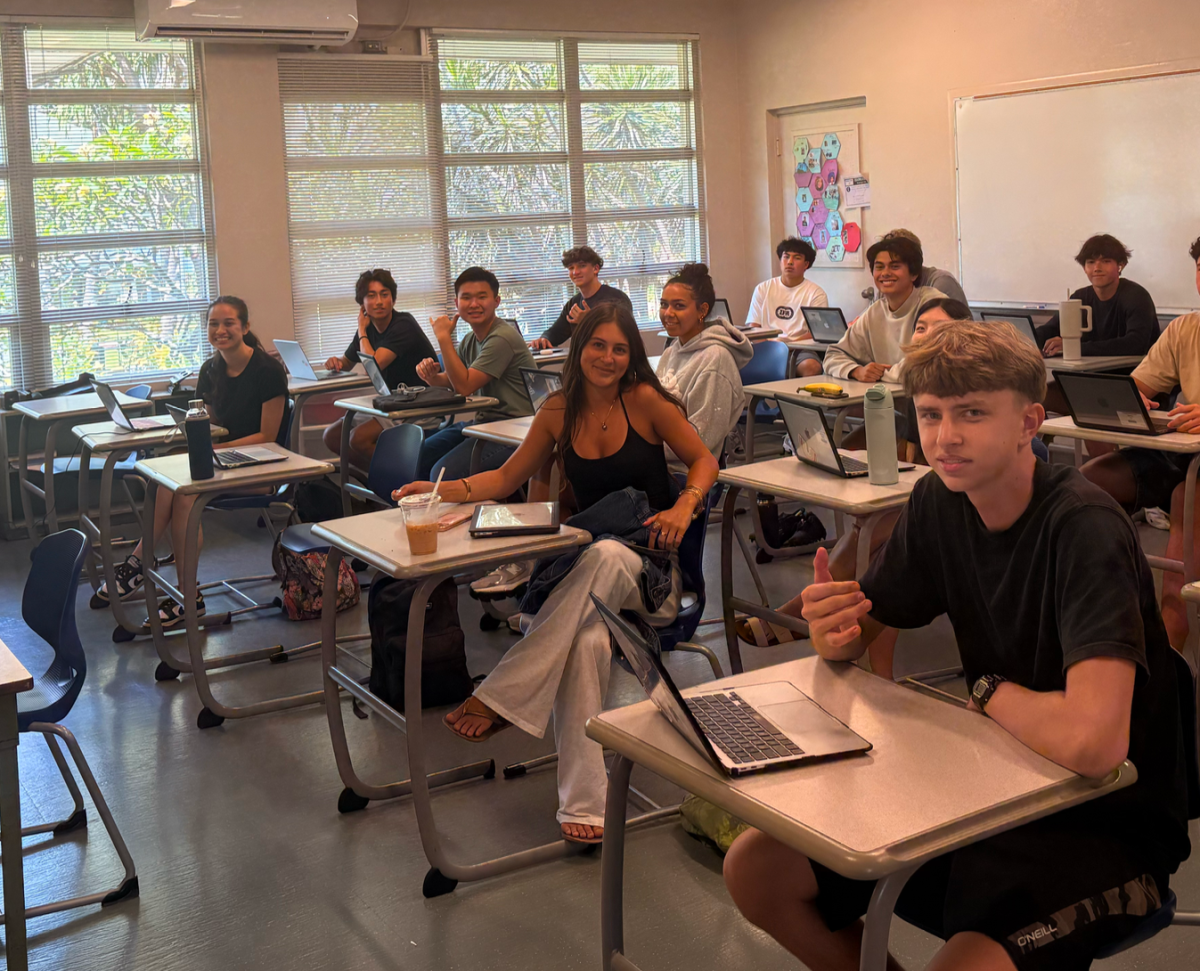
One such small step may lie in a course already offered at Punahou: Money Management. An elective open to juniors and seniors, it covers topics from budgeting to managing a brokerage account. When I asked Cali Weidner ’26 whether she felt prepared for life after high school before taking the class, she explained that while her parents had talked to her about money and stocks, “if they hadn’t, I definitely wouldn’t have been,” adding that the course expanded beyond that foundation into areas like real estate investing that she could even teach back to them [her parents].
Caleb Liu ’26 echoed this, noting that “in money management we learned about investing in stocks, setting up a mortgage… the math is basic, but it’s actually useful.” Most students in the class can point to at least one concept they found genuinely valuable, and often worth sharing with others.
In contrast, some students feel that their classes are dominated by busywork, leaving them without a meaningful sense of learning or even the ability to recall a single concept from the curriculum. The solution seems straightforward: make certain mandatory classes optional, while mandating courses such as money management that students consistently find practical and valuable.
From an administrator’s point of view, however, the answer is not so black and white. As Dean Kamiya (one of the class of ‘26’s deans) explained, “one of our primary objectives is to prepare you academically…which I think we do well,” emphasizing Punahou’s primary commitment to intellectual development. At the same time, Mrs. Kamiya noted that practical skills are not ignored entirely, stating, “there’s a whole host of adult skills that we hope that students gain…and we’re doing different things to help students in that,” pointing to initiatives like financial literacy sessions during Activity Days and Advisory.
Still, these efforts are largely optional and one-off events, raising the question of whether they are actually effective at reaching the class population as a whole. When asked whether learning about financial literacy should be a requirement for seniors, Mrs. Kamiya highlighted the school’s philosophy: “We put a very high priority on student choice.” Thus, rather than mandating a full course on financial literacy like money management, she suggested a more integrative approach, explaining that, “there may be elements that we do feel are essential…maybe we do those things as a part of advisory or SURF .”
Interestingly, administrators argue that Punahou already teaches certain real-world skills, just not always in obvious ways. “One of the biggest life skills… is actually time management and priority-setting,” Dean Kamiya said, pointing to the school’s unconventional schedule. With rotating days, free periods, and increasing independence, “all of those things actually prepare you so well for college.”
While this may be true, time management alone cannot substitute for understanding credit, loans, or investing, basic financial skills that carry immediate consequences, for good or for worse, after graduation. While some may argue that the financial literacy of children is the responsibility of parents, not all families have the knowledge, time, or resources to teach it effectively. The result is a widespread gap in young adults’ financial literacy, an issue that could be mitigated by making such education more prevalent, if not required. After all, it doesn’t make sense to prioritize choice over education in an area where students will inevitably have no choice but to participate.
Ultimately, Punahou’s administration reflects an openness to incrementally incorporate basic financial lessons and other practical life skills into existing structures. However, the question remains it to whether these “little things,” as Dean Kamiya described them, will actually be implemented, or whether future students will still find themselves, like many seniors today, learning the ropes of money management only after they’ve already stepped into the real world.