
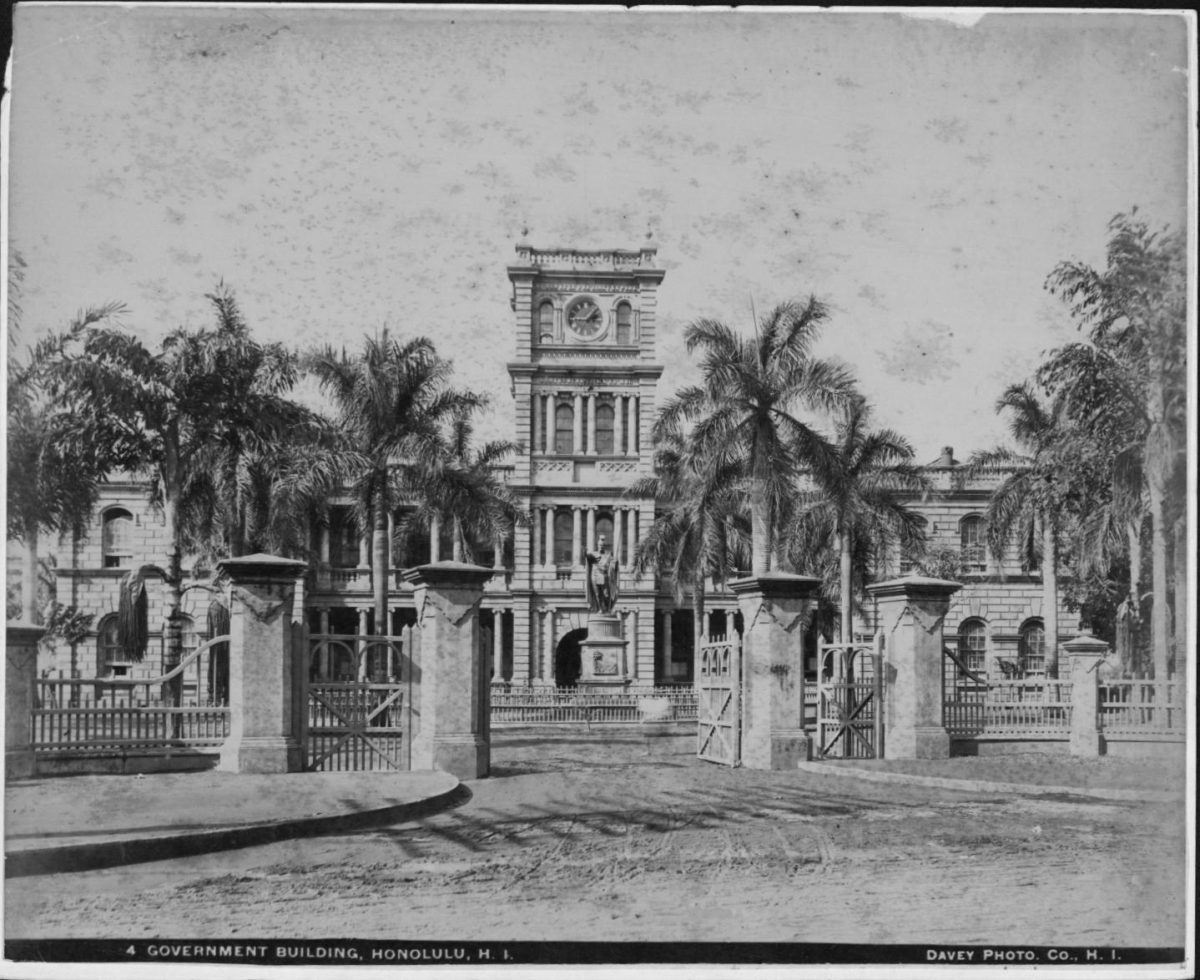
Since its inception, the Judiciary History Center (JHC) has worked towards its mission to “interpret and inform the public about the judicial process and Hawaiʻi’s legal history from wā kahiko (the past) through kēia manawa (present day).” Last summer, I volunteered at the King Kamehameha V Judiciary History Center, where I had the privilege of working as a Collections Assistant under Ms. Brieanah Gouveia, Curator of Collections & Programs. I interviewed Ms. Gouveia about the Judiciary History Center’s role in promoting civic education and the significance of perpetuating history and culture on a broader scale.
As a kamaʻāiīna (long-term resident) from Hawaiʻi Island, Ms. Gouveia always knew she wanted to return home to help preserve Hawai‘i’s material culture and history. For her educational background, she graduated with a BA in art history at Roanoke College before earning her MSc at the University of Glasgow. Her education largely focused on the history and laws of museum collecting, repatriation, and provenance, and continues to shape her commitment to historical accuracy and civic education. She began working for the JHC in 2020, but started her current position as Curator of Collections & Programs in 2022.
Ms. Gouveia and I discussed the historical influence the JHC has had in encouraging civic education. As we conversed about the entrenched gaps in Hawai’i’s civic education, she also acknowledged contemporary obstacles to civic education and how the JHC has continuously endeavored to mitigate them.
The Historical Predicament of Hawaiian Civic Education:
In 1978, after more than a century of European and American colonization, the Hawai‘i State Constitution was amended to reintroduce and expand Hawaiian cultural, linguistic, and historic education. In the last Constitutional Convention of 1978, a constitutional amendment mandated the state promote the study of Hawaiian culture, history, and language (Hawaiʻi State Constitution). However, it wasn’t until 2015 that the DOE established its Hawaiian Studies Program and Ka Papahana Kaiapuni Hawaiʻi (Hawaiian Language Immersion Program) to formally offer a statewide curriculum through the Office of Hawaiian Education.
Since 1978, there has been clear progress in teaching Hawaiian culture, indicated by an increasing number of Hawaiian-immersion schools. Despite this, many youth, even those born and raised in Hawaiʻi, still lack knowledge of fundamental aspects of the land’s civic history. This could be attributed to competing DOE requirements, standardized testing, and US college admission criteria that indirectly discourage Hawaiian studies. The DOE’s prioritization of general “American” and European histories further preserves this issue. With lackluster tools and resources to teach Hawaiian studies, teachers and schools are individually pressured to use their own discretion and knowledge to interpret and implement the state’s educational policy. As a result, the responsibility of teaching Hawaiian history and culture has expanded beyond the public school system to include humanities-based organizations, nonprofits, and community historians.
Organizations such as the JHC strive to bridge this educational gap. The idea for what would become JHC sprouted in 1976, when former Chief Justice William S. Richardson appointed a volunteer board of advisors to establish an educational facility during the last major renovation of the historic building (Aliʻiōlani Hale). In 1984, Chief Justice Richardson’s idea finally took fruition: the board was officially established under the 501(c)(3) nonprofit, “Friends of the Judiciary Center of Hawai‘i.” Since then, the nonprofit has promoted civic education by supporting JHC’s research exhibits, hosting public events, creating professional development workshops, and providing public access to archival records from the JHC’s collection.
While the JHC remedies many of the DOE’s shortcomings regarding cultural education, they have also worked alongside the department. Mr. Matt Mattice ‘80, Executive Director of JHC, has had the honor of managing JHC’s partnership with the DOE through school field trips, teacher workshops, and curated civic lesson plans found on the JHC’s website. The partnership connects educators and students across the islands, and shares Hawaiʻi’s history with teachers abroad. Mr. Mattice stated, “We are lucky to have the support of the Judiciary’s leadership. The two Chief Justices I have worked under have been steadfast in their belief in the JHC’s responsibility to promote an understanding of the Judiciary’s function and how the third branch of government interacts with the other two branches.”
The Current Standing of Civic Education
In recent months, the Federal Administration has cut an unprecedented amount of the budget allocated toward public education and the non-profit sector. So, naturally, our conversation shifted towards the recent challenges around funding for museums, humanities-based nonprofits, and public education.
Ms. Gouveia voiced that historic preservation and cultural perpetuation are more crucial than ever for the survival of Hawaiʻi’s identity and values. She explained that if we, as citizens of both Hawaiʻi and the United States, do not actively record and teach about our histories and stories, we are at risk of losing them— and this is already happening. She continued to explain how many processes and democratic institutions are losing public interest and trust, or are not being properly sustained for many reasons.
Establishing a more robust curriculum with standards for civic studies and Hawaiian education would require the DOE to petition the Hawaiʻi State Legislature for budget increases. On a structural level, the department would need to ensure proper implementation by hiring more specialists to create educational resources and teachers to carry them out. Expanding civic education to integrate Hawaiian history will require copious resources from the DOE, public schools, and partnering institutions such as the Judiciary History Center. This demonstrates why the JHC is crucial to the development of an informed and engaged population in Hawaiʻi, and why funding for the humanities is needed more than ever.
The Judiciary History Center’s Approach:
Ms. Gouveia described the History Center as a “bridge,” explaining how the JHC presents and promotes civic history that is intertwined and connected to the environment we live in today. The JHC’s exhibits, education services, and public programs highlight Hawai’i’s historic culture and adapted legal systems. She added, “We have the opportunity and responsibility in our quaint History Center to create a space where our local communities…[and] cultures can be authentically expressed.”
Following the idea of serving as a “bridge,” the JHC approaches civic education through content-focused, immersive strategies. They partner with individuals and organizations to bring historic artifacts and cultural pieces into the museums, providing visitors with a physical connection to material history that schools can’t necessarily replicate. Since 1989, JHC has hosted free public events featuring prominent, insightful speakers.
For instance, last October (which was Honolulu Pride Month), the center welcomed former Hawaiʻi Supreme Court Associate Justice Steven Levinson, current Associate Justice Sabrina McKenna, and former ACLU Attorney Dan Foley to reflect on the legal history of marriage equality in the US. Justice Levinson shared insights about the deciding opinion he authored in the landmark case, Baehr v. Lewin (1993). This case was the first time in history that a state supreme court recognized the right to marriage equality for all, regardless of sex or gender. Justice McKenna reflected on the impact the case had on her law students, and Dan Foley explained the unique argument he crafted to help his clients win that case.
Accompanying this event, JHC installed eight pop-up exhibit banners in their 1913 Courtroom to share the history of LGBTQ+Māhū rights and stories in honor of Honolulu Pride. Despite Hawai‘i Supreme Court’s legacy as a forerunner of LGBTQ+ civil rights and liberties, this pop-up exhibit is the first exhibit of its kind to be displayed in a government building in Hawai‘i, demonstrating the intersection between Hawaiian legal history and the ongoing battle for civil rights.
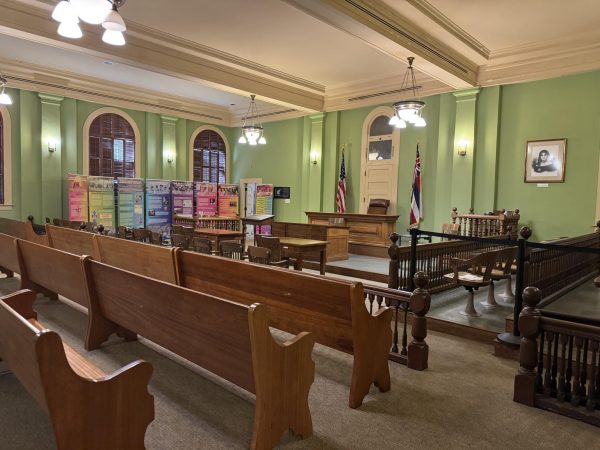
As Ms. Gouveia noted, reliance on the State Government can’t be the sole solution to building a civically informed and active community; every teacher has a responsibility to incorporate Hawaiian history, language, or culture as appropriate and to the best of their abilities. On an individual level, we all must strive to seek out and share the broad truth of Hawaiʻi’s history and encourage people to become civically involved. Ultimately, as Ms. Gouveia stated, “Right now a child is being left behind…not getting the education they are entitled to under state law. You can play a part in building a better future for Hawaiʻi by being the next generation of responsible and passionate citizens.”
Leo K • Dec 25, 2025 at 6:45 am
Thank you for helping out the local community, and spreading awareness. We need all the help we can in these trying times.