
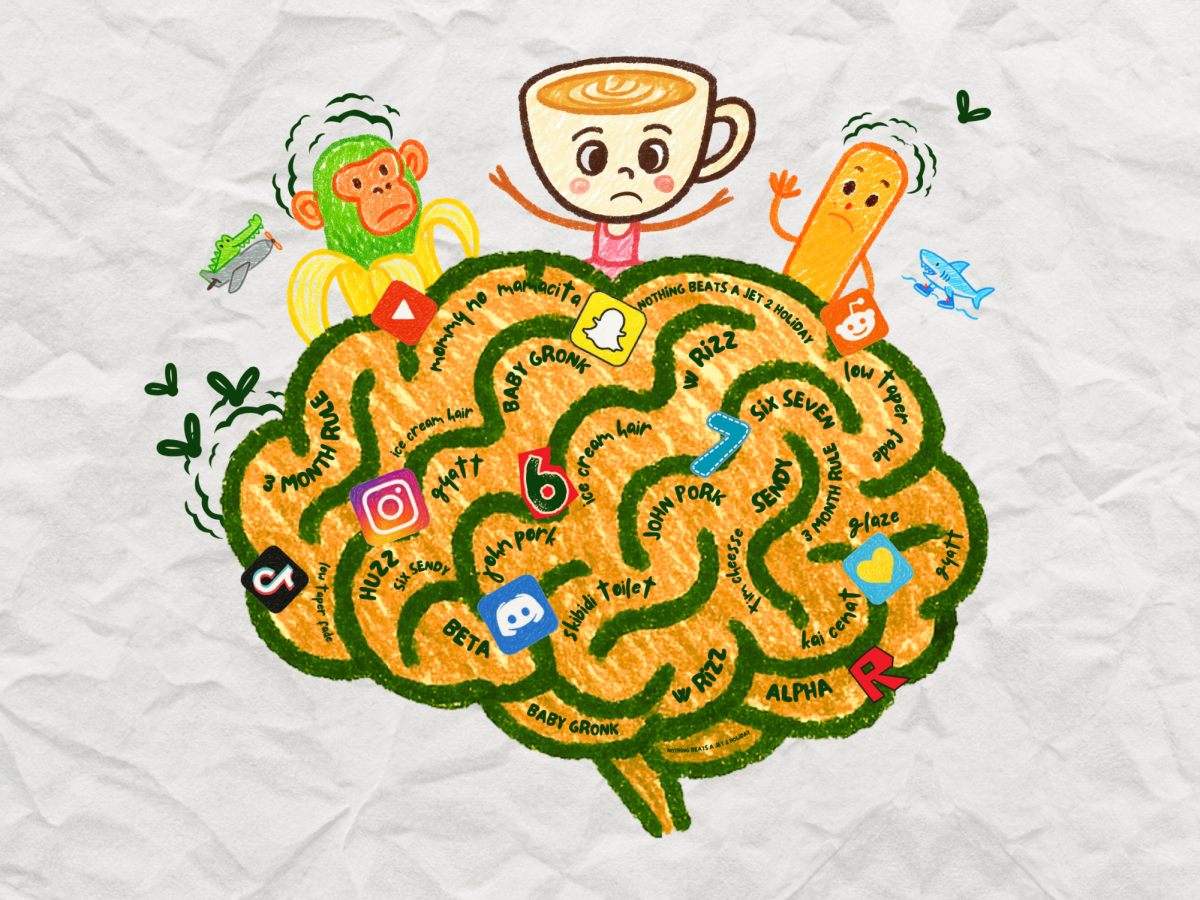
It’s official: Punahou School, known for forging talented and innovative individuals, has succumbed to an epidemic of brain rot among students. Whether it be the middle schoolers yelling random Italian phrases such as “Bombardilo crocodilo,” or the Academy students not being able to go 10 seconds without yelling “67”, it’s no secret that brain rot has now crept its way into our campus. However, Punahou isn’t the only school. Millions of students fell victim to these mindless memes, and while seemingly harmless on the surface, in reality, they can be more harmful than intended.
The term “brain rot” was first coined on the internet in 2007, initially being used to describe having an unhealthy obsession with a piece of fictional media. However, in recent years, the usage of the word has skyrocketed by an enormous 230% between 2023 and 2024. From this increase, the meaning slightly shifted, the new definition roughly referring to idiotic terms and memes that “rot your brain.” Brain rot is typically found when scrolling mindlessly through social media platforms like YouTube, TikTok, and Instagram, and considering how often teenagers doom scroll, many high school students can find it on their feeds.
But why exactly is “brain rot” popular? Well, for many, including myself, brain rot phrases can be addicting, and since many of the memes don’t require any thinking to enjoy, they can serve as a way to detoxify from the stress school causes, shutting down our brains for a “quick” 4 hours of doom scrolling. Social media also plays a big part in promoting brain rot. Many social media apps have short-form content, and this high-stimulation content triggers our already skewed dopamine, making us find the bizarre humorous. In a sense, brain rot is the digital form of junk food. It’s addictive and bad for you, but incredibly difficult to resist.
With this brief summary, brain rot may not seem all that harmful. However, the biggest issue is the fact that, because it’s meant to be mindless, many don’t quite understand what any of the words imply, and this escapism covers very controversial phrases and disturbing definitions. The most recent form of brain rot, “Italian brain rot,” expresses these concerns. Outdated brain-rot phrases, that used to be very popular, such as “Bombardino Crocodilo” and “Tralalero Tralala,” seem harmless and funny, but in reality, their true meanings are much darker than many students understand. For example, the backstory behind “Bombardino Crocodilo” roughly translates to “a flying, bomb-loving crocodile who bombs children in Gaza, Palestine. He also feeds on the spirit of your mother….” Furthermore, the exact translation includes profanity, revealing the true nature of most brain rot and highlighting the importance of ending its spread.
However, for some, it’s too late to escape the brain-rot mindset. Many students have gone overboard into the brain-rot rabbit hole. After asking an anonymous sophomore student to demonstrate and explain his view on brain rot, he stated, “Oh my airball, just let me cook fam! Brr brr Patapim, brain rot means that I am him. Brain rot is like fanum taxing the Capuccino of an Assasino. Imagine if Tung Tung Tung Tung Tung Tung Tung Tung Tung Sahur had a low taper fade. He would be so Sigmalicious and Skibidi.” Now, whether or not he was doing a bit, this is a clear model of what else could follow for many others if Punahou students continue to consume so much brain rot: a lack of proper communication skills, reduced attention span, and an overall harder time focusing and critically thinking in school.
In a more serious interview with Steven Yang ‘27, he commented, “Ever since the rise of the skibidi toilet meme, a lot of my friends have used brain rot, turning our everyday conversations into ‘Skibidi,’ ‘Rizz,’ and ‘that’s not Sigma.’ Although it was fun at first, after a few months, it got quite annoying, especially with a few friends who always use brain-rotting terms. For example, one of my friends in particular couldn’t have a break when we learned about sigma bonds in AP Chemistry.”
Brain rot’s impact on students has also been seen by teachers, and many are worried about the well-being of their students. Mrs. Wells, an English 1 and 2 teacher, expressed her concerns and own opinions, stating, “You see it a lot in the sense that there are things that previously would be perceived as common knowledge that are just not anymore. Picking word choices for assignments, I know I’m supposed to elevate their language and vocabulary usage, but there are times where [I’ll even use] words that I think are simple, and students won’t know the definition of them. This then affects how they perform because they don’t know what the assignment means. I think there’s also a lack of encouragement to read, which is the biggest thing you see happening because of brain rot. Students are used to quick things being explained and something they can read in a few seconds, as opposed to having to read longer and more complex texts. We all need those brain breaks, but I believe those breaks go more towards the rot, and that stays longer than the actual coursework. Sometimes, brain rot will take away not just the intellect, but the time.”
Unfortunately, no matter the steps Punahou has taken to address the issue, it’s up to the students to reduce their own brain-rotting addictions. But let’s remember that Punahou isn’t the only school struggling with students engaging in brain rot. Schools worldwide have fallen victim to these two-faced terms, and by seeing the impacts brain rot has on them, it’s important to realize that it’s more critical now than ever for Punahou students to go down a different path and preserve their sanity. Now, while there aren’t any exact methods for fixing your brain-rot addiction, students are advised to watch less short-form content, go outside more often, and not do their homework the night before.
Leo K • Dec 25, 2025 at 6:44 am
Thank you for your insights! Surprised and unfortunate that even Punahou hasn’t been immune to this epidemic.